

With the first cold weather snap behind me, I wanted to share the results of a little experiment I ran to answer this question:
Does having your heating on low and slow use more gas than having it hot with short bursts?
This is the question I often get asked when I’m discussing low temperature heating. Most people say that having your heating on all day would result in far more gas usage.
Low and slow here refers to having a low flow temperature on your boiler e.g. around 45°C or less. UK houses typically have their boiler set to 70°C, with a thermostat turning it on/off to regulate the internal temperature.
I’ve shown in my YouTube video (Adventures in Low Temperature Heating) that low flow temps keep my 1950s house warm. But am I using more gas than I need to?? Would I better whacking the boiler back up to 70 and letting the thermostat do its thing be more economical?
To help me answer this question, I did two tests over the past few days, taking advantage of the snow and subzero temperatures we’ve had here in the midlands.
The test consisted of two parts. First, I ran my boiler using flow temps between 40°C and 45°C and then I switched up to a flow temp of 70°C.
The weather hasn’t been completely consistent over these periods, so, as ever, direct comparison of one day to another is very difficult. I also didn’t help matters by having to move my outdoor temperature station (Avoid Outdoor Temperature Sensor Mistakes: My Own Experiences)
A quick word on Control
Before jumping into the data, I want to quickly explain that I used two different control strategies during this test.
For the low flow temps, I simply switch the boiler on and let the house reach a natural temperature. This is how weather compensation and load compensation work. You use the flow temperature to control how much heat you’re pushing into the house. Higher the flow, the more heat. The house will reach a natural balance between how much heat you put in vs. how much heat the house loses.
For the higher flow temps, I opted to use a software controlled PID thermostat (https://github.com/Alexwijn/SAT) with the internal temperature coming from an average of all the room temps in my house. Rather than my boiler being on all the time, this thermostat will turn the boiler on and off to try and maintain the internal temperature.
A quicker word on Efficiency
To get the efficiency figures I state below, I’m using the excellent Open Energy Monitor, which computes all that for me!
You can see my boiler here – https://emoncms.org/app/view?name=TomsBoiler&readkey=484aa317fd15cfef28cc3c7a7a2bedd4
First test: 40°C/45°C flow temp controlled
On Tuesday, we woke to snow all around and a temperature of just above zero (purple line). My heating was set to come on at 5am, with a temperature of 40°C.
The purple line is hard to see on the small images, so you can click on them to open
Unfortunately, this didn’t happen smoothly as my Mixergy tank decided it needed some help form the boiler, pushing the flow (orange line) up to 70°C. The heating itself didn’t come on until about 7. I raised the flow temp to 55°C in an effort to speed up warming and pushed it back down to 40°C about an hour later.

As you can see from this chart, the boiler basically ran continuously. I pushed the flow up to 42°C around lunch time as the house was just a little cold and that pushed the internal temp up to around 19.5°C (the blue line), which seems to be our comfort sweet spot.
I repeated this the following day, and you can see the boiler kicked in at 5am and pulled the flow temp up to 40°C. As you can see, the outside temp stayed closed to zero.
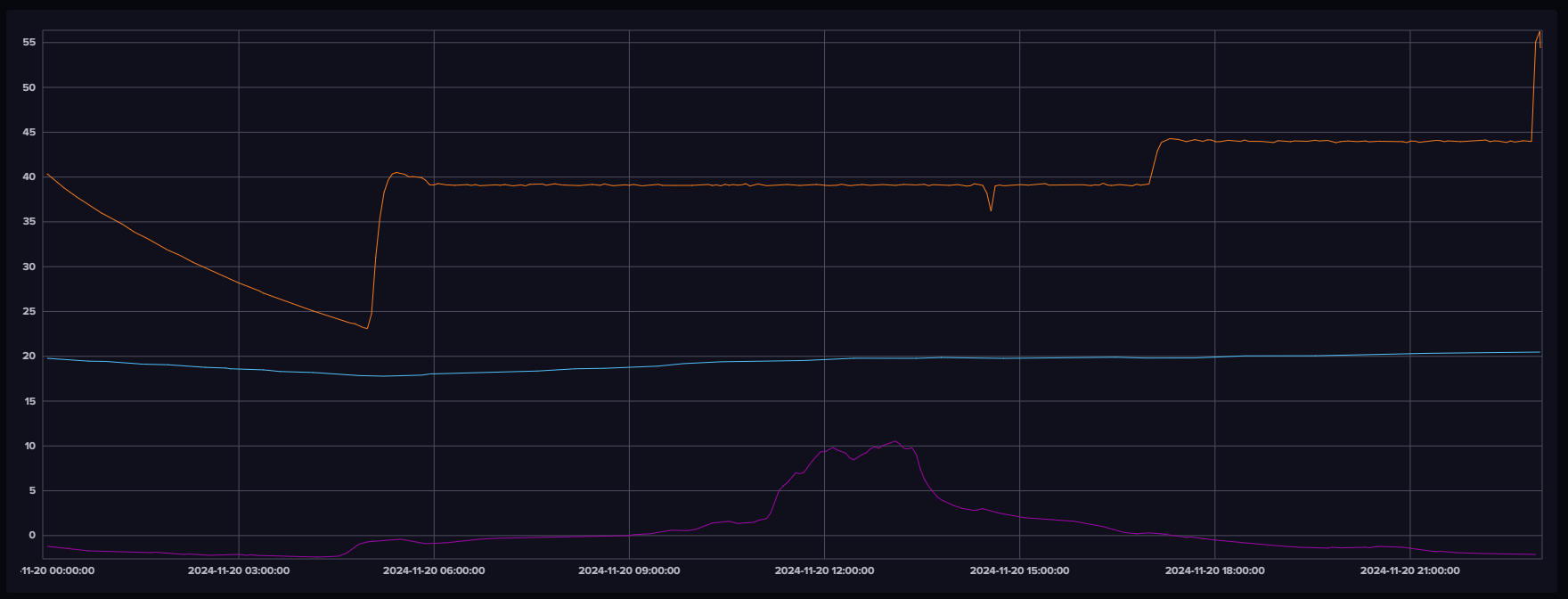
Towards the end of the day, I pushed the flow temp to 45°C to see what would happen and ended the day pushing the flow temp to 55°C.
The third day was pretty much the same story.
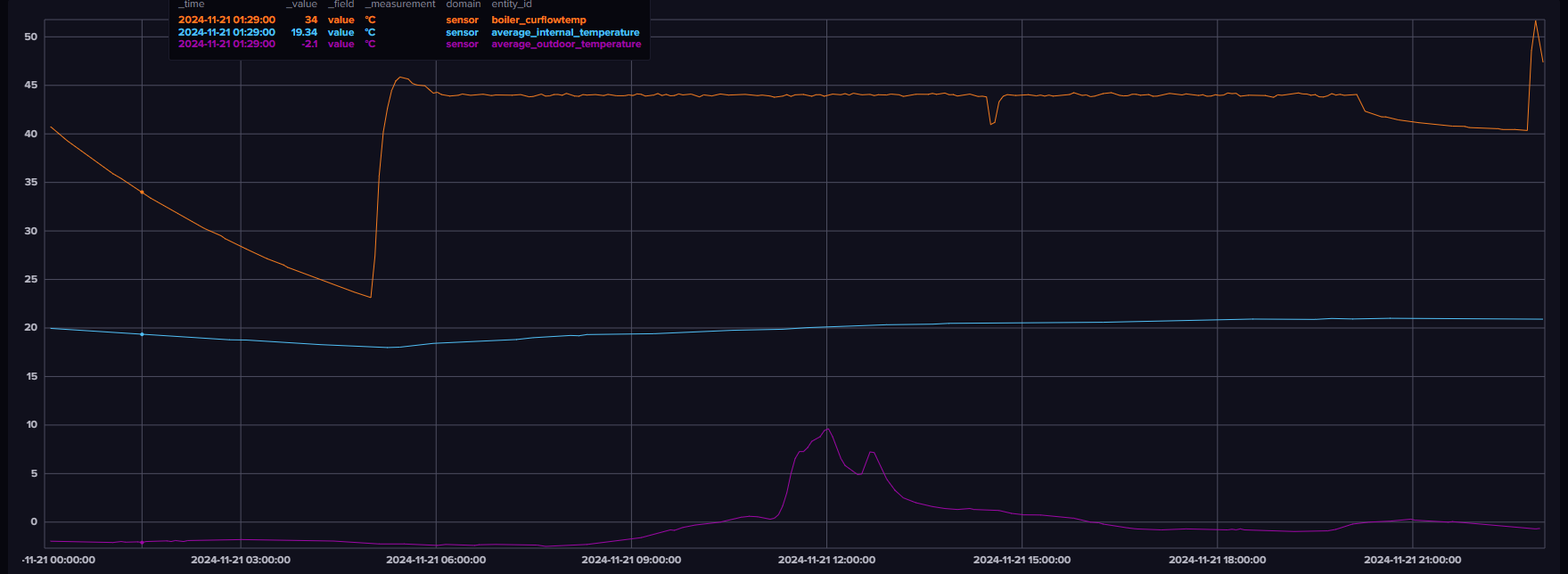
The outside temp spiked, but that’s due to sun exposure (Avoid Outdoor Temperature Sensor Mistakes: My Own Experiences)
Second Test: 70 Flow, thermostat controlled
Friday morning started with a 70°C flow.
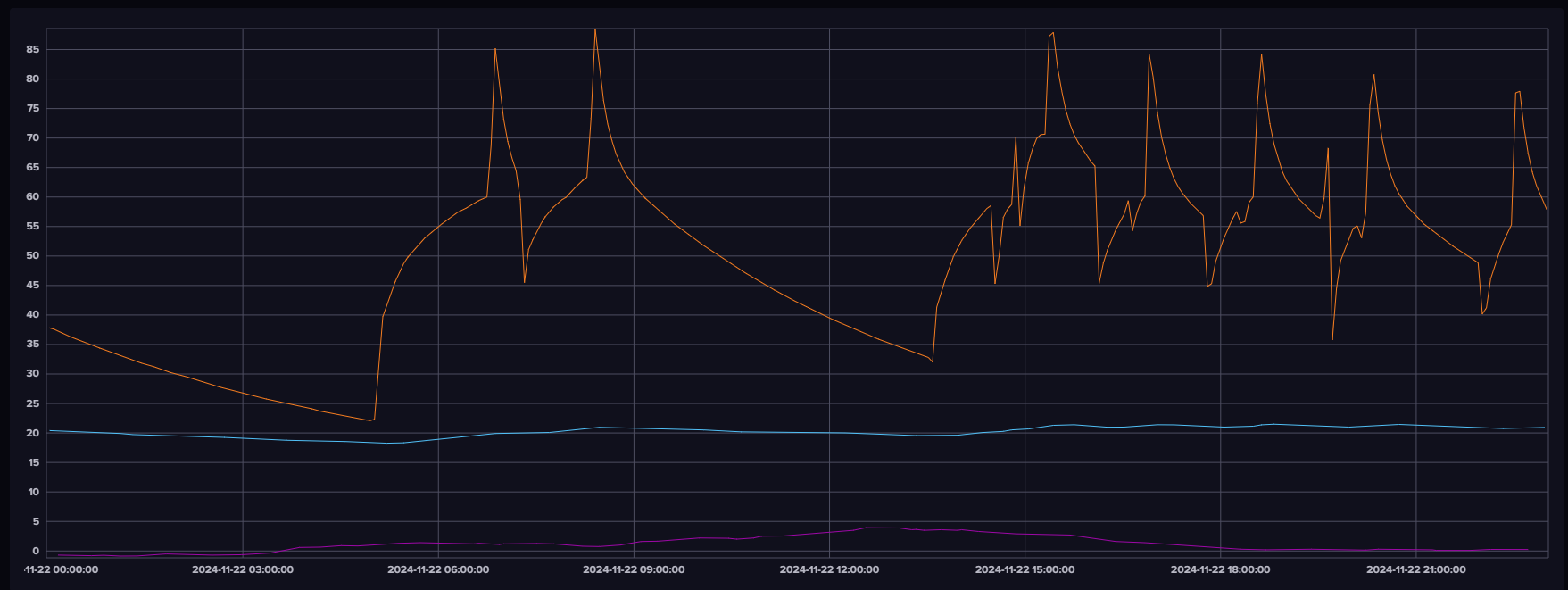
This graph shows very different behavior. In the morning, my Home Assistant thermostat wasn’t behaving, so the heating was just on, and the boiler itself was cycling (you can see the two peaks in the morning as the flow reached up as high as 85°C!!! before the boiler cycled.
By lunch time I had tweaked Home Assistant and it was better behaved, burning several times over the afternoon and maintaining an internal temp over 21°C (which is a little warm for us, so I dropped it down by one degree!!)
You can see the daytime temp climbed up to giddy heights of over 3°C. I had moved the thermometer, so this wasn’t solar related, it was just slightly warmer.
Saturday morning was a completely different story altogether. Overnight, the outside temperature started to rise, so when we woke in the morning, we were all sweating in our beds!
This is because the heating comes on at 5:30 and the 70°C flow temperature pushed the internal up quite quickly, which I hadn’t accounted for, so bedrooms were quite warm whilst we were still all asleep.
I decided to leave the heating on anyway, just in the interests of science.
So, which used more gas???
Here is the week in question. I don’t have Saturday as that’s today and Octopus can lag behind in the date. I had to draw in the value on Saturday as Octopus is a little behind in their weekly chart. It was 125kW.

Tuesday, Wednesday and Thursday (40 flow) show the usage climbing with Friday (70 flow) showing a slight decrease and Saturday a larger drop. So far, it would seem that running your heating low and slow is about the same as blasting on/off with a much higher flow rate.
The picture becomes more interesting when we look at the outdoor temperature over the week

Let’s take Monday and Saturday. On Monday, the daytime temp was about 6 degrees and on Saturday, the mid-day was 10, With the radiators blasting out heat from time to time, the downstairs got uncomfortably warm, and I had to resort to wearing shorts, which is ridiculous!
** I need to point out that there is a slight difference between Octopus consumption figures and Open Energy Monitor’s figures. It can be a few %, but not enough to quibble about **
The gas usage between those days was about the same 119kW on Monday and 124kW on Saturday. So even thought it was warmer on average, the boiler used more gas on the 70 flow. The 70 flow had a much lower efficacy, 82% vs 89%
It becomes even more stark on the mid-week days.
On the 19th, the temperature never climbed above 2 and my boiler, running almost continuously at 40°C, used 137kWh with an efficiency of 89.2%.
On the 20th the temperature hovered below freezing for most of the day, with a consumption of 148kWh with 91.9% efficiency. I pushed the flow from 40°C to 45°C at 5pm to see what difference that would make.
On the 21st, the outdoor temp stayed below freezing again, this time down around -2 for a large portion of the day. Boiler used 162kWh with 89.7% efficiency.
And that brings us to Friday the 22nd. With the flow set to 70°C, the boiler used 144kWh of gas and managed an efficiency of 89.8%. The average temp was still very low, down around 1 degree.
Wednesday is the closest at 148kW, so let’s compare these.
Wednesday was a good deal colder, starting at -2 and ending at below freezing. Unfortunately, my hasty relocation of my outdoor sensor has thrown the readings, but it was very cold all day with the snow staying on the ground.
The boiler ran continuously that day from 5am until 11pm. You can even see the jump from the 40°C flow to 45°C flow, which I did at 5pm. Usage jumped before settling down.
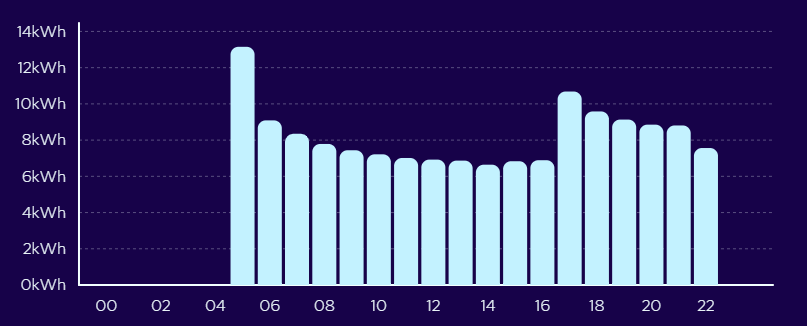
Friday’s run was a different story. You can see the massive burn in the morning as the system is trying to pull the water up to 70. 20kWh burned in the first hour 😱. I believe this would have been much higher had I not range limited my boiler’s maximum output to 50%.

You can see the gap where the SAT thermostat wasn’t working properly until I fixed it at lunch time.
So, both days used about the same amount of gas, despite one being warmer. Not looking good for high flow temperatures….
If we continue and compare Monday and Saturday, the picture gets worse for that pesky 70 flow.
The weather on Saturday was much warmer, with an average of 8°C. Monday was a little colder with an average of only 5°C.
Mondays’ run was nice and steady, using 119kWh (89.1%)
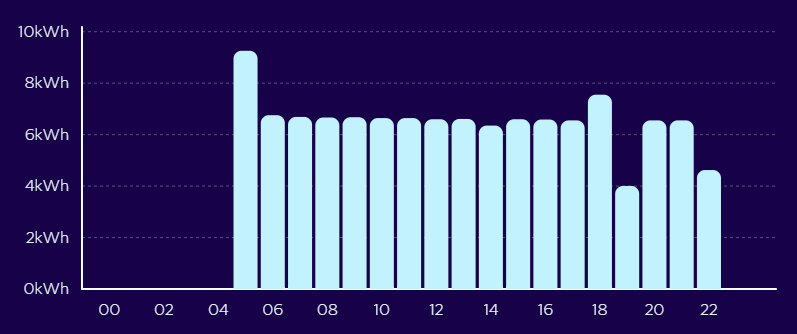
Saturday’s run was a little more jagged. Forgive the difference in the graph as I’ve had to grab it from my phone (Octopus don’t seem to offer the same data between web and app)

My automations let me down, so the heating was on all night. That accounts for about 28kWh of additional usage. However, because the heating was on, the house was warm, meaning there was no “long burn” needed first thing. Let’s split the difference and call it 112kWh.
Again, usages are very similar, but it was *warmer* on Saturday. It burned the same amount of gas, yet it was warmer. Efficiency was also down, at 82%. Down to the higher return temps?
Conclusions
This was obviously a very short and very impromptu test, taking advantage of a cold snap, but the outcome is very positive.
Low and slow is showing definite signs that it’s better. Despite the colder temperatures, running the boiler continuously at a lower flow delivered more comfort for less consumption. Sure, it will take longer to warm your house in the morning, but it will use less gas doing it. I got around this by starting the heating earlier in the morning. I’m even more happy doing that now that I’ve seen the other alternative!
If you want to give low flow temps a try, I whole heartedly recommend it. If you have a combi, boiler it’s as easy as adjusting the heating dial. Here are two resources which will help – Heating Hub and Nesta.
If you have a hot water tank, you will need to seek professional advice.
If you’d like to find out more about my experiments with Low Flow Temperatures, be sure to watch my YouTube Video called Adventures in Low Temperature Heating, which I mentioned above.
What’s Next?
I’ve put my flow temp back down to 40°C and for December, I’ll continue monitoring and experimenting. I need to get property Weather Compensation setup, so my boiler’s flow is linked to the weather automatically, rather than relying on me to tweak it. I will also continue to use the smart thermostat integration and see how that behaves, especially as it’s supposed to learn the best pattern.
Will it be better than just having it on all day? Yes, because once the outside temp gets back up above 2°C or 3°C, my boiler will start cycling, regardless of the flow temperature because it’s oversized (YouTube: My Big, Stupid, Oversized Boiler). Hopefully a PID thermostat will offer the best of both worlds.
If you’re still reading, thanks!
If you do give the low flow temps a try, please let me know how you get on!


 @tomasmcguinness
Leave a reply to Tim Robinson Cancel reply